



On Sep. 8, Jacob Coxon quit Anthropic and posted that the big AI labs are “gambling with our lives.” The post went viral and sparked renewed debates about AI safety and alignment.
Evan Hubinger, who works on alignment at Anthropic, quote-tweeted Coxon to state that he puts the chance that AI kills all humans at greater than 10% within the next decade. The same week, UN human rights chief Volker Türk told the Human Rights Council that AI without binding rules is an “existential risk to humanity.” Databricks CEO Ali Ghodsi, meanwhile, has countered these claims, arguing the existential risk (‘x-risk’) from AI is close to zero.
Many—us included!—are left wondering who to believe.
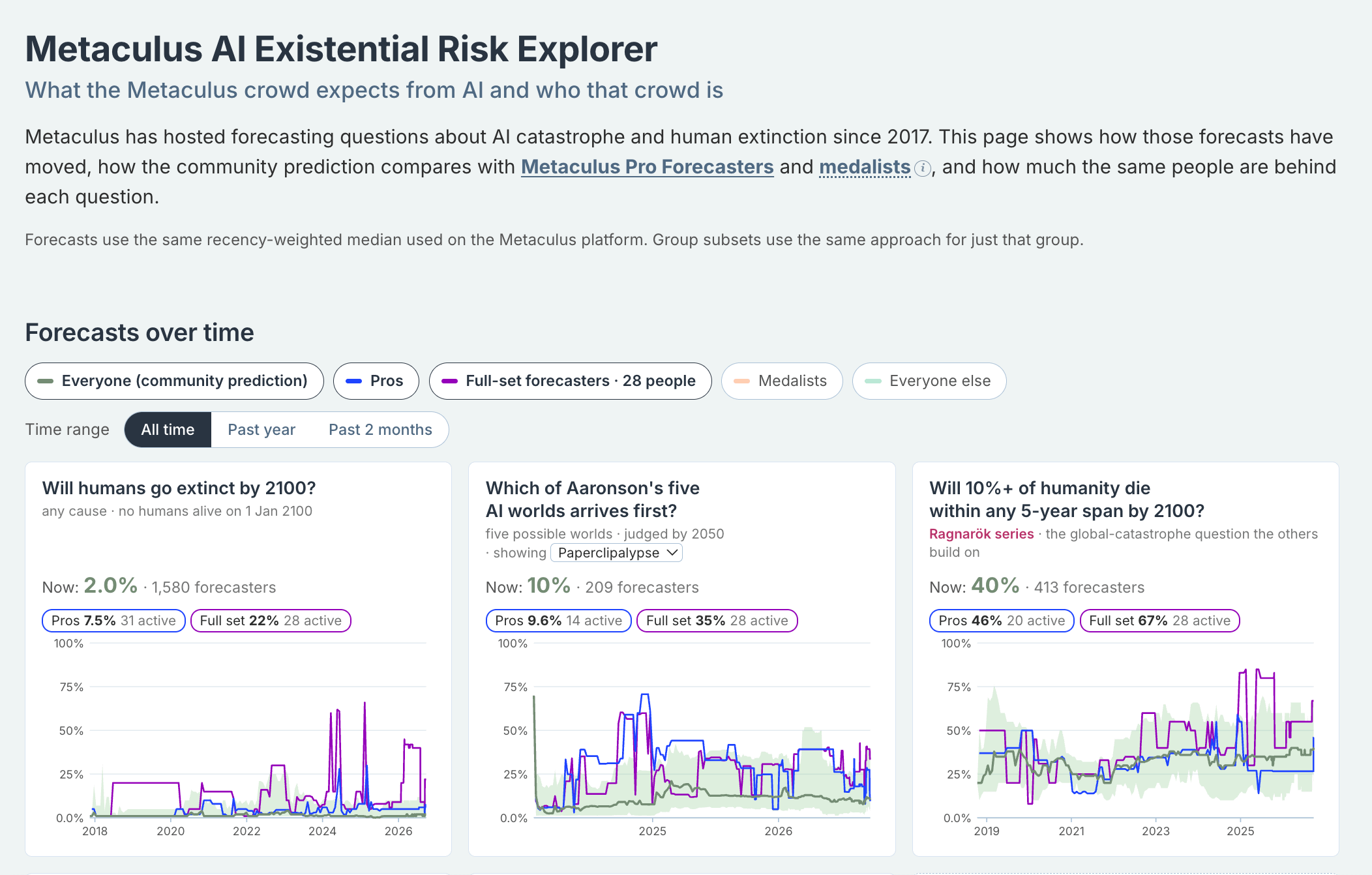
Metaculus has been collecting forecasts on this topic since 2017, from thousands of people, on questions with fixed wording and resolution criteria. In an effort to cut through the noise, Ryan Beck, our Director of Forecasting, pulled together the AI catastrophe and extinction questions from Metaculus and analyzed who left predictions. The result is the Metaculus AI Existential Risk Explorer.
What follows are key takeaways from what that data reveals.
Note: Forecasts on Metaculus are live, so these numbers are subject to change. Figures in this post are current as of Sep. 23, 2026.
The crowd says 2%
Our longest-running question on this asks whether humans will go extinct before 2100, from any cause.
The Metaculus community prediction is 2%, from 1,580 active forecasters.
That’s 1 in 50. Far below Hubinger’s number, and for a window 7 times longer. But on the other hand, if someone offered you a 1-in-50 chance of losing everything, you’d want to know a lot more before dismissing it.
One caveat: extinction here means “no human alive” by 2100. That’s a narrower frame than most people have in mind when they talk about AI x-risk, and it’s the strictest question we have.
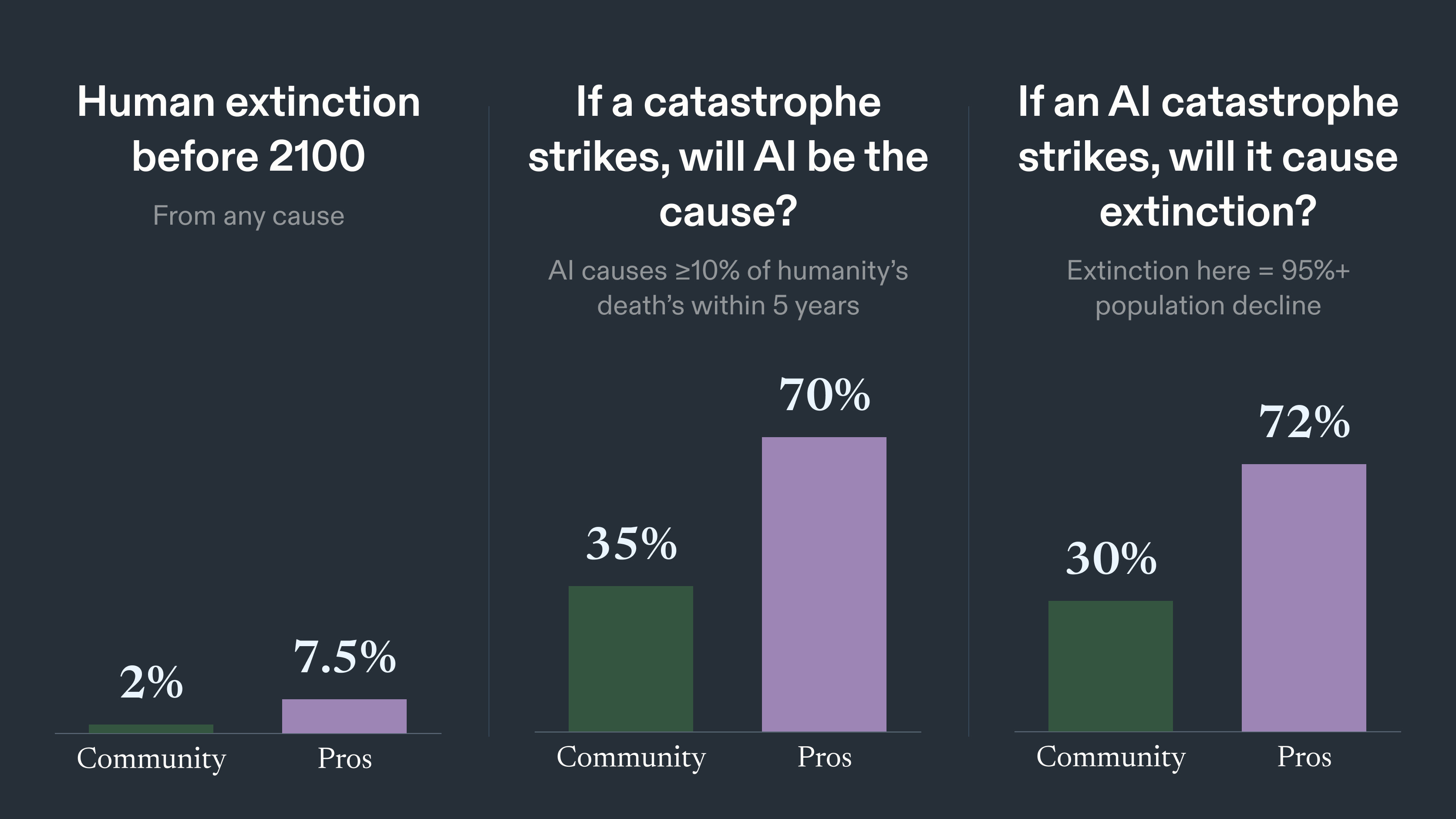
Our Pros say 7.5%
Metaculus Pro Forecasters are people we recruit to forecast because of their track records on questions that have already resolved.
On the same extinction question, the 31 Pros currently active put it at 7.5%, nearly 4x the crowd.
Ask about AI directly and the gap moves
Scott Aaronson and Boaz Barak once sketched five ways AI could go: Fizzle, Futurama, Dystopia, Singularia and Paperclipalypse. The last one references the famous AI paperclip maximizer thought experiment and is the doom scenario, where AI is hostile or indifferent to us and we go extinct as a side effect. In our forecasting question, we ask which of those worlds we’ll be closer to by 2050.
The community gives Paperclipalypse 10%.
Pros give it 9.6%.
The 28 people who’ve forecast on all five of our core x-risk questions give it 35%.
Here the Pros and the crowd are essentially tied. The gap comes from those 28 full-set forecasters, who also put human extinction by 2100 at 22%.
Where the Pros split from the crowd
We also ask whether world population will fall by at least 10% within any 5-year stretch before 2100. That’s the generic global catastrophe question: pandemic, nuclear war, whatever. The community says 40%. Pros say 46%.
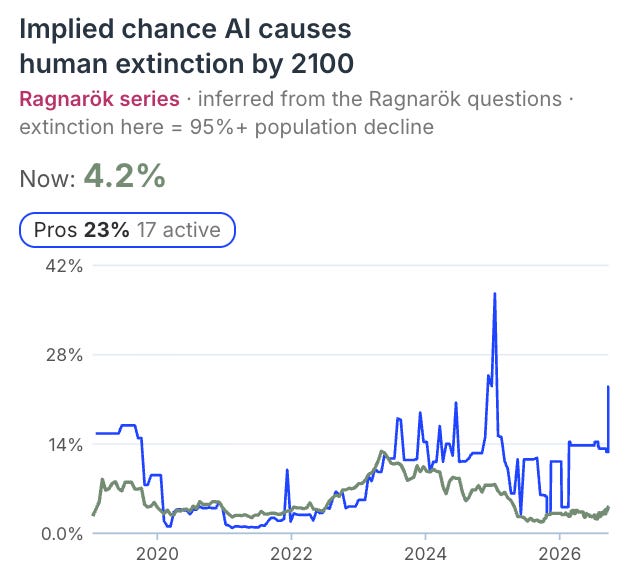
Two follow-up questions in the same series ask what caused the catastrophe, and how bad it got. Multiply all 3 and you get an implied chance that AI kills 95% or more of humanity by 2100: 4.2% for the community, 23% for the Pros, 34% for the full-set forecasters. Nobody forecast that number directly, but it’s the closest thing here to the question everyone is actually arguing about.
The individual links are where the Pros separate from everyone else. If a global catastrophe strikes, they put 70% on AI being the cause, against the community’s 35%. If an AI catastrophe strikes, they put 72% on it wiping out 95% or more of us, against the community’s 30%.
The number you get depends on the question you ask
This is the caveat we’d apply to every “p(doom)” figure you’ve seen this month (including ours).
Take Paperclipalypse, a world where AI drives us extinct. The community puts it at 10% by 2050, and human extinction by 2100 at 2%. The full-set forecasters say 35% and 22%. Read literally, those numbers don’t comport; if AI wipes us out by 2050, we’re also extinct by 2100, so the first number should be the smaller of the two. Among people who forecast both questions, fewer than half (43 of 91) keep their own 2 numbers in that order.
We can’t know the exact reason for this divergence.
To that, the two questions also aren’t asking exactly the same thing, and the Paperclipalypse resolution criteria illuminate that. If nothing has resolved it by 2050, a panel meets and votes on which of the five worlds is closest to the real world. It seems that some forecasters think that loss of control scenarios are closer to Paperclipalypse, while others view them as closer to Dystopia. Part of the gap probably comes from how the question was created. We wrote it to match the 5 worlds Aaronson and Barak described, so it inherits their categories instead of establishing our own, and forecasters read Paperclipalypse in different ways.
Extinction by 2100 asks for one specific, total outcome. Paperclipalypse can be interpreted as asking which direction the world went. Read that way, 35% and 22% can both be honest answers from the same forecaster.
The Pros show the same thing from another angle. Their implied 23% from the Ragnarök chain is about 3 times their own 7.5% on the direct extinction question. The 2 questions define extinction a bit differently (95%+ dead vs. no one left), but that’s a big gap for one group to hold.
Either way, the lesson holds, and it’s useful well beyond this post. When anyone shares a probability of AI catastrophe, be sure to ask exactly what was asked, and by when. And if you’re the one asking, whether you’re talking to an expert or a friend at dinner, be as specific as you can.
A small group carries a lot of the signal
The most striking numbers here come from a few dozen people. 28 forecasters have weighed in on all five of the core questions, and 14 to 31 Pros are active on each one. Aggregates from groups that size move around. On several of these questions, the Pro figure rests on fewer than 10 effective forecasters, because recent forecasts get more weight. One person updating can move it.
And of course, nobody has a track record on extinction specifically, because that question can only resolve once (and hopefully never!). So treat the Pro numbers as a strong signal from people with good records elsewhere.
Do note that it’s possible there’s a selection effect at play here; the most worried people might be the ones forecasting the most x-risk questions, and therefore have higher probabilities. On the other hand, these same people may have also spent the most time thinking about it and deeply considering the risks, so it’s worth taking their research and reasoning seriously.
What Happens Now? Forecasting the Fallout from the Hugging Face Incident

The 2026 OpenAI agent cyberattacks, also known as the Hugging Face Incident, has become one of the biggest news stories of the summer, and for good reason: it’s a highly visible demonstration of the risks posed by increasingly autonomous artificial intelligence agents, which AI critics and “doomers” have been
Where that leaves us
People who forecast professionally, and get scored on it, put human extinction from any cause by 2100 at 7.5%. That’s higher than the crowd, and it covers a window 7 times longer than the decade Hubinger was talking about.
Extinction is a high bar, though, and it doesn’t cover everything people mean when they say AI doom. On Paperclipalypse, the question that leaves room for the rest of it, the Pros are at 9.6%, about level with the crowd. The 28 forecasters closest to this topic are at 35%, and they put extinction by 2100 at 22%. Those are big numbers from a small group. And for that group, the more room a question leaves for bad AI outcomes short of extinction, the higher they go.
If you think they’re wrong, leave your own forecast and/or reasoning. These questions are open, and have all been aggregated into the AI Existential Risk question series. Your forecast counts the same way theirs does. Here are a few to get started:
And check out our full Metaculus AI Existential Risk Explorer to read the data for yourself.
ICYMI
Radiant: Map the Predictions Behind Your Plans

TLDR: Free credits while Radiant is in open beta. Take a look, check out a sample map, or read on to learn more.
Fewer than half keeping their own two numbers in order is my favorite stat here. Even allowing for the panel-vote wording, it looks a lot like Tversky and Kahneman's Linda problem.
What's the track record of the Metaculus Pro Forecasters vs. the Metaculus community prediction? Do they typically outperform the aggregate?